About
 |
Me |
|
|
My studies |
|
|
Photo safari in Norway |
|
|
Interests and favourite things |
Tibetan |
|
|
|
Dalai Lama |
|
|
The paths |
|
|
Our art |
|
|
Links |
 |

HH Dalai Lama
"The Dalai Lama, the leader of the Tibetan nation and people, fled Tibet from Chinese aggression into exile in 1959. ... he has become one of the world's great exponents of non-violence. For this, he has won (world-wide) admiration ... and was awarded the Nobel Peace Prize in 1989. [More]
 |
" [Interview]
Contents
The Potala Palace in Lhasa, Tibet
 |
| The Potala in Lhasa, Tibet (click for another view) |
The sumptuously decorated palace was for 400 years the winter home of the Dalai Lamas. The Chinese government has earmarked money to renovate the palace.

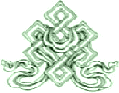
The glorious endless knot of Tibet
|
|
| The glorious endless knot |
In Buddhist Symbols in Tibetan Culture, Dagyab Rinpoche, a
Tibetan lama, explains the source and meaning of nine groups of commonly
used Buddhist symbols, beginning with the Eight Symbols of Good Fortune,
which include the Wheel and the Glorious Endless Knot. He also describes
how Buddhist symbols are used to remind practitioners of the
"interrelations between inward and outward, between mental activities and
material appearances." Intricate images serve as tools for meditation,
they also link up past and future in part.
Dagyab Rinpoche further illuminates the concepts of Tibetan
Buddhism, which is grandly visual.
A source link: Buddhist symbols of Tibet
Carpet industry
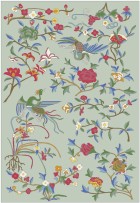 |
| Tibetan carpet |
Flag of Tibet
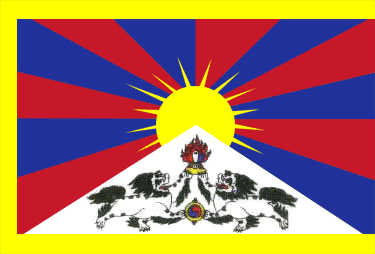 |
| Flag of Tibet |
From the symbolism of the national flag of Tibet:
- The snowy mountain in the centre represents the nation of Tibet, "the Land Surrounded by Snow Mountains".
- Six red bands spread across the sky represent ancestors of the Tibetan people: the six tribes Se, Mu, Dong, Tong, Dru and Ra. Red bands (for the tribes) and six dark blue bands for the sky represents incessant enactment of the virtuous deeds of protection of the spiritual teachings and secular life by the black and red guardian protector deities of Tibet.
- The sun with its rays stand for equal enjoyment of freedom, spiritual and material happiness and prosperity by all beings in Tibet.
- The pair of snow lions on the mountain slopes are blazing with the manes of fearlessness, which represent the country's victorious accomplishment of a unified spiritual and secular life.
- The three-coloured jewel held aloft represents the ever-present reverence of the Tibetan people towards the Three Supreme Jewels (or objects of refuge): Buddha, Dharma (law, righteous life, etc.) and Sangha (community life, etc.).
- The swirling jewel (yin-yang-emblem) held between the two lions represents such as principal virtues for handling life and modes of conduct fit for life.
- The surrounding border of yellow represents such as the purified teachings of the Buddha.
"Today, posession of the Tibetan flag within China is a criminal offence: People have been given prison sentences of two years specifically for this thing alone. It is displayed at most demonstrations. In 1988 a group of protesters were marching around the Jokang temple lead by a man carrying this flag. A Thai businessman reported seeing a soldier kneel down, take aim and shoot the flag bearer." [Source C]
"In China today it is refered to as "the snowlion mountain flag", as to call it the Tibetan Flag might infer some degree of legitimacy on its bearers." [Source C]
Tibetan flag, source A
Tibetan flag, source B
Tibetan flag, source C
Clever and good dogs
 |
| Tibetan terrier, called "the holy dog of Tibet". |
Tibetan terriers FAQ
Tibetan terriers
 |
| Tibetan Spaniel |
Tibetan spaniels- "Yes, they are good with children."
- "Tibbies adapt fine to apartment life." [Ibid]
Tibetan mastiffsFourth
Etc.Introducing some parts of Tibetan culture.
© Summer 2000, T. Kinnes. Designed for Netscape 4.0 and upwards, mainly.
Last updated: Autumn 2004.