
The Well 16
 4 4  1 1  7 7  |
 |
 |
 |
 |

 |
 |
 |
 |
Was Sir Henry Neville the Guru of God?
Yogananda said he recognised certain parts of the Tower of London. In that tower Sir Henry Neville (1564-1615) sat imprisoned and wrote Shakespeare works, researchers insist.
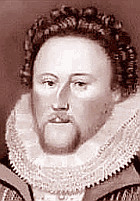 |
| Wasn't Sir Henry Neville the author of Shakespeare's works? |
- Bible. One verse daily — try to feel it.
- "Song Celestial." Edwin Arnold's [tedious blank verse] translation of the Hindu Bible, Bhagavad Gita.
- Passages from Shakespeare. [Emphasis added]
COMPLICATION: From the SRF headquarters we have a statement that they do not find fault with Yogananda's guidelines, and his wisdom is believed to be faultless. For all that, not every kriya yogi under the guru is as devoted to his Shakespeare as the Bhagavad Gita and Christian Bible, for example.
Why does Yogananda put such special stress on the Shakespeare readings? Is his intent to bore others insatiably? Or does he want them to attune to someone in the entertainment industry at a time when actors had to compete with dancing bears and bearded women to attract the public? Yogananda could have been blissfully unaware that "guru Shakespeare" perhaps was just a straw man for Sir Henry Neville, courtier, diplomatist, and the real writer of Shakespeare works, if two researchers have got it right . Opinions differ among scholars as among others. But there is much evidence that suggests that Neville wrote the plays attributed to Shakespeare, and no one else.
Henry Neville is one of several Elizabethan figures to have been mooted as the "real" Shakespeare. Very recently two academics claim to have discovered compelling evidence to prove Shakespeare was a well-paid frontman for the real author, the true creator of the bard's celebrated plays and sonnets. The two, Brenda James and William Rubinstein, say the evidence is difficult to ignore.
For centuries scholars have asked how a grammar school boy whose education was cut short at 12, and who never travelled abroad, could have gathered the breadth of learning displayed in his work. "Scholars have always been puzzled as to how Shakespeare wrote plays requiring detailed geographical and political knowledge and advanced skills in reading Latin, Greek, French, Spanish and Italian sources, yet ceased his formal education at age 12." The new book reduces Shakespeare to little more than an avaricious money lender whose heroic qualities are the result of having greatness thrust upon him.
Neville was a wealthy and distant relative of Shakespeare's. He was also his contemporary, an extremely well-educated linguist who travelled widely throughout Europe. Neville had wealth, learning and opportunity; he was familiar with details of court life at home and abroad on some countries. And both James and Rubinstein say there is an exact correlation between the subject of the plays and where Neville was at any given time. He was once the English ambassador to France, and events in his life also shed new light on the development of the plays. He visited Vienna, where Measure for Measure is set, and northern Italy, where a series of Italian plays, such as Romeo and Juliet and The Merchant of Venice, were set. The chronology of Neville's life and the chronology of the plays always match up, asserts Professor Rubinstein.
Neville, unlike Shakespeare, had access to a detailed story of the Bermuda shipwreck of 1609, which seems to be the base of The Tempest. There are also striking similarities of style and vocabulary between Neville's private and diplomatic letters and the Shakespeare plays and poems. Word frequency analysis also reveals a statistical correlation. Besides, some scenes of Henry V are written in French, which Neville spoke but Shakespeare did not, and so on.
New documents known to have been written by Neville while in the Tower, contain detailed notes which later ended up in Henry VIII. "There is far more evidence to suggest that Sir Henry Neville wrote the works of Shakespeare than there is of Shakespeare himself," says James.
If all this be true, who is the past-life Yogananda, William or Sir Henry? Isn't it doubly interesting, considering Yogananda's claim of having been Shakespeare? But perhaps interesting theories or complications do not count much among followers or dupes . . . And as for Shakespeare, he was "the last person you would imagine able to write such matter", says Mr Rylance of the Globe theatre. But then again there is the Shakespeare authorship material in support of Shakespeare . . . [Source 1] [Source 2] [Source 3]
Bizarre Complications
"Several incarnations at least must pass before he will have another such opportunity" - Another element to take into account is that if or when the disciple is ready to commit again, the reincarnated guru may not, if he has incarnated as someone who does not teach kriya, like Shakespeare or William the Conqueror. Or if the guru is ready, the former disciple may have become unfit for it as a rat or whatever. There are many significant elements that need to match well here. I'll point to a few:There is only one guru uniquely the devotee's own. But if you turn away from the emissary of God, He silently asks: 'What is wrong with you, that you foolishly leave the one I have sent to help you learn the divine science of the soul? Now you shall have to wait long, and prove yourself, before I shall respond again.' He who cannot learn through the wisdom and love of his God-ordained guru will not find God in this life. Several incarnations at least must pass before he will have another such opportunity."- P. Yogananda. Spring 1974 Self-Realization Magazine, Spring 1974:6. From a talk at MC, 8/17/39
Yogananda spoke to disciples of many past lives. He told he had been William Shakespeare (no initiations given by that one, maybe no superb plays either, if a Sir Henry Neville with the needed background wrote them with Shakespeare as his straw man). And he told he had been William the Conqueror (who never initiated anyone either, to my knowledge), and a Spanish figher, and so on. He also said he was there when Jesus was born. He also said he had been the Hindu bowman Arjuna who had to share his wife with his four brothers, but who is not known to have been the guru of anyone either. This adds up to that a kriya-teaching incarnation of the guru has not been easy to come by, no matter how ready you may have felt through the millenniums. And SRF teaches that you shall have to get back to you guru, that birth and death mean huge sufferings, and the lives in between can hardly be all pleasant too. That is what SRF teaches. [MORE].
This leads up to: If Yogananda told the truth about "several incarnations must pass" - what if the disciple is ready when Yogananda is William who fights but does not initiate, William who helps Sir Henry Neville as his straw man, and so on? It looks so awfully difficult to catch such an initiating entity at the right time (in his right mind and incarnation is perhaps better said).
There are other conclusions to be drawn too, but this guesswork does suggest that "several incarnations, at least" is not far-fetched if we study the claimed Yogananda incarnations and how very little they do to initiate anyone that we know of. Is it time to be scared of something?
 |
 |
 |
 |
| Literature | SECTION | First Page |
Ak: Yogananda, Paramahansa. Man's Eternal Quest. Los Angeles: Self-Realization Fellowship, 1975.
Ap: Mieder, Wolfgang (main editor), Stewart A. Kingsbury, and Kelsie E. Harder: A Dictionary of American Proverbs. (Paperback) New York: Oxford University Press, 1996.
Ay: Yogananda, Paramahansa. Autobiography of a Yogi. 1st ed. New York: Theosophical, 1946. Online. [oaks.nvg.org/pv6bk12.html]
Ebu: Encyclopaedia Britannica. Encyclopaedia Britannica 2006 Ultimate Reference Suite DVD. London: Encyclopaedia Britannica, 2006.
Op: Simpson, John, and Jennifer Speake. The Concise Oxford Dictionary of Proverbs. 3rd ed. Oxford: Oxford University Press, 1998.
Pa: Yogananda, Paramahansa. Autobiography of a Yogi. 11th ed. Los Angeles: Self-Realization Fellowship, 1971. [Cf]
Say: Yogananda, Paramahansa. Sayings of Yogananda. Los Angeles: Self-Realization Fellowship, 1958.
CLICK on 'Literature' for the references of about 2000 works.
ANNOTATIONS: Code letters (acronyms and initial words) in square brackets in the text refer to works. Click on 'Literature' to see examples. Page references are put right after code letters. And the abbreviation cf. means "compare". [MORE].
SITE SEARCH: The 'Search' link gives access to dictionaries and more.
REFER: Prefer the standard 'location address' on top of the page(s).
PILOTING: Note the clickable text links on top of the page. [MORE]
DISCLAIMER: Two disclaimers intertwine: [A] [B]
© 2005–2006, Tormod Kinnes. All rights reserved — September 2006.