| |||||
|


| Reservations |
|
|
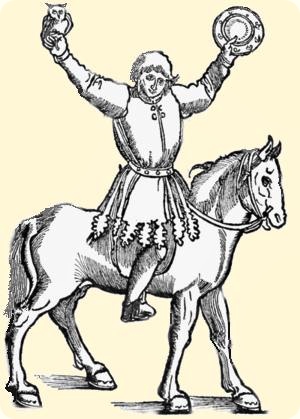
Till Owlglass TalesThese tales are retold from a book that was first printed around 1500 AD as Ein kurzweiliges Buch von Till Eulenspiegel aus dem Lande Braunschweig (A Brief Book on Till Owlglass from Braunschweig Country), and attributed to Hermann Bote. It is one of the most popular books ever that originates in German, and has been translated into many languages. The book consists of farce tales, and Till is a clown. The complete Till Tales in German are onsite.
1a. How Till Owlglass was born, baptized three times on one day, and who his godfathers wereTill was born by the forest Elm in the village of Kneitlingen in the Saxonia country. His father was Claus Owlglass, his mother Ann Wibcken. The parents sent the child to the village Ampleben to be baptised and called Till Owlglass. Till von Uetzen, the lord of Ampleben, was his godfather. Ampleben is the castle that Magdeburg people destroyed over fifty years ago with the help of other cities so as to do away with robberies. The church and the village by the castle are now owned by the worthy abbot of St. Aegidien, Arnolf Pfaffmeier. After Till had been duly baptized the people carried the child into the beer house and flocked to get drunk and merry, and the father was to pay for it all, as the custom was. After some time the parents and their company wanted to carry the child back to Kneidingen. The godmother who carried the child, wanted to hurry over a bar across a brook between Ampleben and Kneidingen, but she had had much beer after the child baptism. She and the child and some others fell into the pool and soiled themselves and the child so much that the child nearly choked. The other women who accompanied the godmother helped out with the child. They brought him to their village, washed him in a boiler and made him clean and lovely again. Thus Till Owlglass was baptised three times on one day: once in the chapel, once in the dirty pool, and once in the boiler with warm water. 1b. How Owlglass when a child, gave a marvellous answer to a man who asked the wayOnce on a time the father and mother of Till Owlglass went away for some time and left him in the house. Then came a man riding by, and he rode his horse half into the house in the doorway, and asked: "Is there nobody inside?" The child answered: "Yes, a man and a half, and the head of a horse." Then the man asked: "Where is your father?" The child answered; "My father is making ill worse; and my mother is gone for scathe or shame." The man said: "What do you mean ?" The child answered: "My father is making worse of ill, for he ploughs the field and makes great holes that men fall into when they ride. And my mother is gone to borrow bread, and when she gives it again and gives less it is a shame, and when she gives it and gives more it is scathe." Then said the man: "Which is the way to ride?" The child said: "There where the geese go." Then the man rode to the geese, and when he came close to the them they flew into the water. Then he did not know not where to ride, but turned again to the child and said: "The geese have flown into the water, so I don't know what to do or where to ride." The child said: "You must ride where the geese go and not where they swim." The man departed on horseback while he marvelled of the answer of the child. 2. How all the farmers and farmer's wives complained about the young Owlglass and said he was a good-for-nothing and teaser; and how he rode with his father and in silence let people have a look at his behindsWhen Till got so old that he could stand and walk, he played much with the young children, for he had a merry mind. Like an ape he tumbled on the cushions and in the grass till he was three years old. Then he was eager to learn all kinds of pranks - so much that all neighbours complained among themselves and to his father that his son Till was a prankster. The father had a talk with his son and said: "How can it be that all our neighbours say you are a prankster?" Till said: "Dear father, I do nothing to nobody, and want to prove it clearly to you. Take me with you on a horse-ride. I will set myself behind you and be quiet. They will nevertheless lie about me and say what they like. Note that well." His father did as suggested by his little son. As they were riding along, Till bared his buttocks so that people they were passing, could see his behinds. The neighbours pointed to him and said, "For shame! What a teaser you are." Till said: "Listen, father. Here I sit in silence and do nothing to anyone. Still the people say I am a teaser." Now the father set his dear son Till in front of him on the horse. Till sat completely quiet, but he gaped and grinned and stuck his tongue out at all they met. People ran up to the riders and said, "What a prankster that child is!" Then said the father to his young son, "You must be born in an unhappy hour. You sit quietly and are silent and do nothing to anyone, and nevertheless people say you tease them." He loved Till so much that he left the land of Brunswick, and settled in the land of Magdeburg, hard by the river Saale. He sorrowed so much that he died from it a little time later, and left his wife and child in great poverty. Till did not know any handicraft, and grew up and got older in knavery - tricks, quips, and quiddities. 3. Claus Owlglass moved away from Kneitlingen to Magdeburg, where his wife was born, where he himself died, and his son Till learned to walk the tightropeThe Mother of Till Owlglass came from Magdeburg. After her husband Claus died she lived with her son in a house there. Being widowed, she became poor, but Till did not want to learn any handicraft till he was about sixteen years old. In the meantime he learnt to entertain and walk the tightrope. For the house had a courtyard that led down to the river Saale and he could practice walking the tightrope across the river. At first he did it in secret, for he did not want his mother to see what he was doing instead of working. First he had the rope fastened from the attic of his mother's house, hoping she would not notice it. She tolerated no foolishness from him, and threatened to beat him for playing on the rope. So once she found him on the rope, got a large club, and tried to shove him off it - so he ran away from her, out through a window and up to the roof where she could not reach him. When Till became a little older he began to perform on the rope again, stretching it across the Saale from the back of his mother's house to a house opposite. Many young and old people noticed the rope and came eagerly along to see him walk across it. They were curious as to what sort of strange show he wanted to pull off. When now Till Owlglass was sitting on his rope and performing at his best, his mother noticed it and went stealthily to the back of her house, where the rope was fastened, and cut the rope in two. As a result Till fell into the river and had quite a bath. The farmers laughed and the boys yelled: "Heh-heh, you have been asking for it for a while already!" The scoffing and screaming annoyed Till so much that he did not mind being wet. Vexed as he was, he did not fear the bath and the peril of drowning as much as the jests of the people who ran after him with much outcry. He started to consider how to get even with them and pay them back for this. In the meantime he washed himself off as best he could. |
|
Bote, Hermann. Till Eulenspiegel: Ein kurzweiliges Buch von Till Eulenspiegel aus dem Lande Braunschweig.. Auflage 16. Berlin: Insel Verlag, 1978. Mackenzie, Kenneth Robert Henderson, coll. The Marvellous Adventures and Rare Conceits of Master Tyll Owlglass, Newly Collected, Chronicled and Set forth, in our English Tongue. London: Trübner, 1860.
Oppenheimer, Paul, tr. Till Eulenspiegel: His Adventures. London: Routledge, 2001.
|
 |
Section | Set |  |
 |
User's Guide ᴥ Disclaimer © 2005–2019, Tormod Kinnes, MPhil [Email] |