| |||||
|


| Reservations | Contents |
|
|
Walrus SayingsA walrus decked in gold is better than an over-laden horse. A walrus is a walrus even if he is finely saddled. A walrus is rarely known by his ears alone. A walrus life well lived goes unheeded by hunters. A walrus that happens to rest on a book pile is not necessarily learned. A wet walrus is nothing to be ashamed of. All is not blubber that comes from the walrus. Comfortable is he who doesn't have a walrus to groom. Don't harness the walrus and the seal together. Don't set out on a journey using someone else's walrus. Don't stop a walrus that isn't yours. Don't try to drive walruses with a stick. Expecting the world to treat you fairly because you are good is like expecting the walrus male not to charge when you get too close. Greatness alone is not all it takes to make a walrus. He who took the walrus up to the roof should bring it down. I am a prince and you are a prince; who will lead the walruses? If a walrus kicks you and you want to kick back, think twice. It is not true that many conformists today welcome the wet walrus in the house as a pet or mopper. Things have not taken such an ugly turn yet. It is unwise to seek wool from a walrus. Little does a walrus know about the song of a nightingale. Never stand in front of a judge or right behind a walrus. Reading Scripture in front of a walrus is not safe. Shallow waters surrounding the North Pole are all right to a walrus, but not to someone who is dressed up for a party in Italy. The account of the walrus is different from that of the walrus-hunters. The walrus' best ornament lies in his nakedness. The walrus knows many things that are good for something. Understanding of a walrus is had by mind, eyes, bristles and so on. Walruses might fly unless the age of miracles is past. We let him in; but then he brought his walrus along, too. When a walrus climbs a ladder, he is up to something unlikely. Whoever plows with a team of walruses must have patience. Would you shear a walrus for wool? You ask the walrus when it is Wednesday?
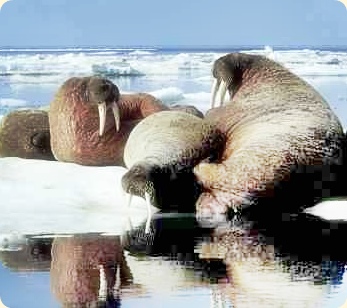
The Walrus DescribedWalruses face an uncertain future. - ◦Melanie Lancaster and Tom Arnbom The "rust-coloured whale": Germanic 'rusta-' (rust), is a form which is found in Norse rostungr, and rosmhvalr, and 'hvalross'. The latter was borrowed from Danish. The world walrus stems from it. Bulls, who may get almost four metres long, weigh two tons. Cows, who may become almost three metres long, weigh over one ton and are bigger than ice bears, they too. The colour of a walrus is pink-to-cinnamon brown. His colour changes from pink-to-cinnamon brown to a lighter shade when he gets into cold water because then his blood vessels get smaller. He lives in the northern waters, and most often in shallow water by ice floes or land. He is found in the entire polar basin. There are two types of walrus - the Atlantic and the Pacific. There are more Pacific walruses than Atlantic walruses. The walrus is the largest pinniped, fin-footed animal in the Arctic and Subarctic areas. Seals and sea lions are fin-footed too. They have to drag their hind ends around on dry land and ice. The walrus on the other hand walks on all four fins. He can move on land as fast as a man can run. The walrus migrates in the spring and fall following the food. The coming of many ice floes tells him when to migrate. His diet consists of clams, snails, crabs, shrimp and worms, ie, bottom-dwelling invertebrates. Clams are the principal food of the walrus. He grubs the clams from the sea bottom with his snout or blow them loose with a jet of water, then sucks the clams from their shells. He can dive down a hundred metres to get his favourite food from the sea bottom. He can eat 4,000 clams in one feeding. The tusks may be the first thing to notice on a walrus. Both the male and female walrus have them. Tusks are made of ivory and grow to be two feet long in the cows and four feet long in the bulls. Both male and female walrus use their tusks to pull themselves out of the water and to crack breathing holes in the ice during the winter. And these long ivory tusks are also used for such as digging for clams and for protection from attack by polar bears, killer whales and local hunters. He also has big whiskers for a reason: to feel around o the dark bottom till he finds food. Then he blows to get the food loose or to make it move so they can get it. He needs it to move because they can't get to it because of his protruding tusks. His thick skin protects him from serious bites and sharp rocks. The skin is also very wrinkly. The wrinkles are like armor and protect him when he fights or "jousts" with other males to earn the right to mate, and protects him from all predators except the orca whale, polar bear, and man. Living in the Arctic is not (too) hard for the walrus because he has blubber under his skin. Blubber is his body fat. It keeps him warm in the Arctic cold. Also, when he is cold he can reduce the blood flow to the skin and blubber to save heat. The Living in Nature Reveals the Being under StudyLeft to themselves in nature, animals have to strive as best they can without man-formed aids to help them. There have been no scientific studies as to how good walruses are at counting and showing tact to one another. It could be a rather interesting subject. However, walruses are adapted to conditions that are remote from ours. We obviously need to understand the gaps between them and us before we think of findings with transfer values and the like. However, do you feel the time is ready for more animal heroines than the well trained Lassies and Willies? Walruses have feelings too, and know when their needs are offended against, or violated. I suggest you leave them be - in the free - and don't try to put petticoats on them - against the inborn dignity of animals that are abused as pets. To be left to themselves with enough space in a congenial habitat could be the best thing to do to a lot of wild animals. Even photo safaris may become burdens before and after exploitations. Wild animals of many kinds are hard pressed by humans, many of them, and some are endangered species. "Man's got to know his limitations," says Dirty Harry (Clint Eastwood) in a movie. The highest is to let walruses be themselves, in conditions that conform to all their needs, and thus remain free. The second highest is to strive for good walrus habitats and walrus righs when there is good time. Animals cannot do that . . . and future generations might thank you. Be Silent and Watch a WhileThe Walrus Hunters is an online book by R. M. Ballantyne. In nature we learn to be silent, observe with ease and study the plots and doings of birds and animals. There are things to learn, such as:
Can we learn something from the Inuits on how to deal with the large, bulky walrus? Yes. But the amount of the tocix chemical PCB (polychlorinated biphenyl) in the blubber is abnormally high today. That is what the researchers have found out recently, advicing especially mothers and coming mothers to refrain from walrus blubber. Why? PCB chemicals have been linked to cancer and other damage in animals and humans. One may be advised against eating large quantities of blubber till it can be proved that it is not contaminated with PCBs. A contaminated walrus bull may get annoyed if humans draw near. The heavy animal can move swiftly in order to defend his territory and is willing to fight for it. |
|
Born, E. W., I. Gjertz, and R. R. Reeves. 1995. Population Assesment of Atlantic Walrus (Odobenus rosmarus rosmarus L.). Oslo: Norsk Polarinstitutt - Meddelelser No. 138. Higdon, Jeff W., and D. Bruce Stewart. 2018. State of Circumpolar Walrus (Odobenus rosmarus) Populations. Prepared by Higdon Wildlife Consulting and Arctic Biological Consultants, Winnipeg, MB. Ottawa, ON: World Wildlife Fund Arctic Programme.
WP: Wikipedia, "Walrus"
|
 |
Section | Set |  |
 |
User's Guide ᴥ Disclaimer © 1998–2018, Tormod Kinnes, MPhil [Email] |